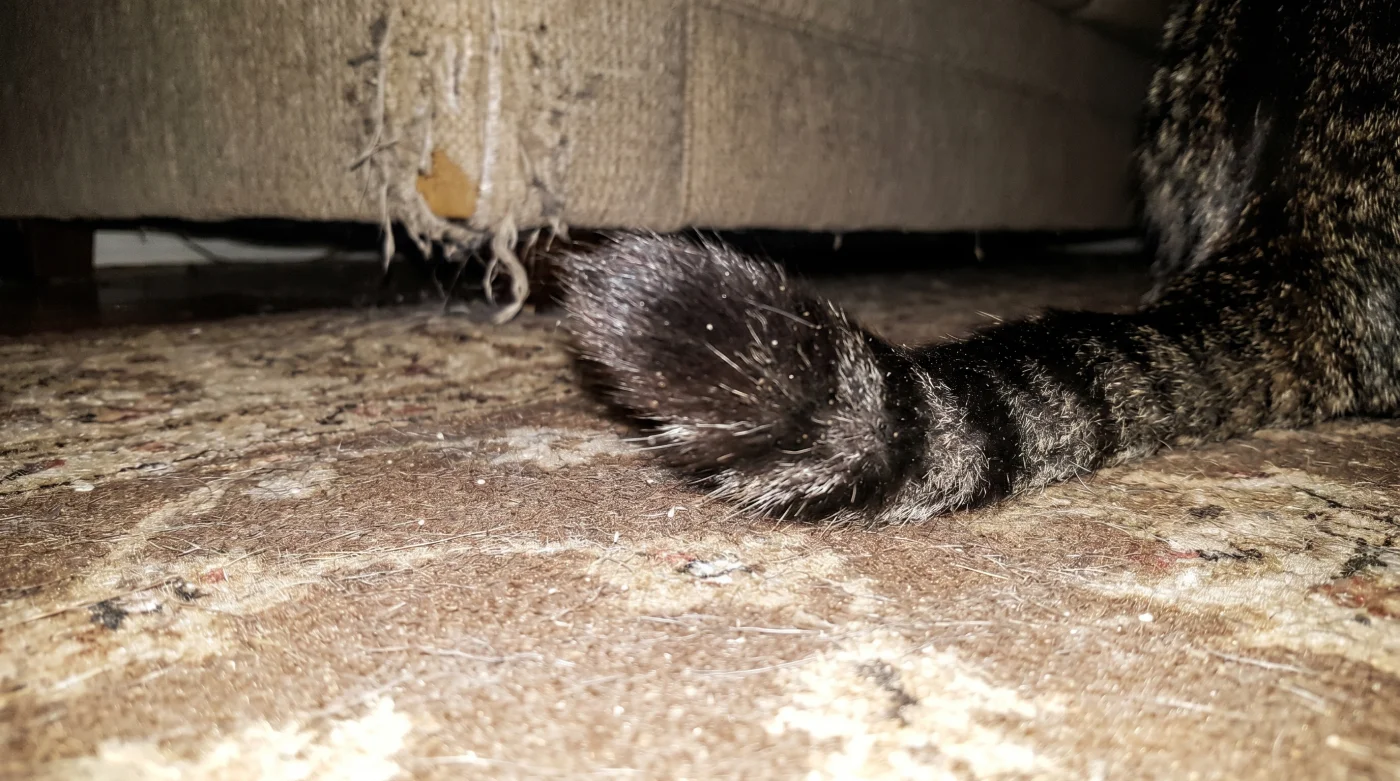
The late afternoon sun pools on the living room rug, warming the space to a comfortable seventy degrees. Your cat is curled on your thighs, vibrating with a heavy, rhythmic purr as you smooth your hand down their spine. Their tail begins a slow, deliberate sweep against the upholstery. It looks exactly like the loose, happy wag of a neighborhood dog.
Then comes the sudden disruption. A sharp flash of teeth and a lightning-fast swat shatter the quiet, leaving you staring at a fresh red scratch on your wrist. Your cat bounds off the sofa, sitting three feet away to groom a shoulder with fierce, agitated strokes.
You wonder what went wrong. The purring was present, the eyes were half-closed, and the tail was moving in what seemed like perfect rhythm. But cats do not speak the same physical language as the canines we are so used to observing. That steady, rhythmic sweep was never an invitation to keep petting; it was a rising alarm bell.
You simply missed the gathering tension of a storm, mistaking the physical overflow of overstimulation for absolute feline contentment.
The Pressure Valve at the End of the Spine
We often treat petting a cat like turning on a faucet, expecting affection to flow endlessly as long as we provide the touch. But a cat’s nervous system is much more like a dry sponge. It can only absorb so much friction before it is entirely saturated. Once that limit is reached, every additional stroke feels less like a comforting massage and more like static electricity crackling against bare skin.
The tail serves as the visible gauge of internal pressure. When a cat is truly relaxed, their tail is still, draped loosely like a heavy velvet rope. The moment it begins to move in a measured, ticking rhythm, the emotional temperature is rising. You are watching the pot just as the water begins to boil, rattling the lid before it spills over.
Marcus Thorne, a 42-year-old behavioral rehabilitation specialist in Chicago, spends his days working with felines deemed unadoptable due to aggression. He notes that almost every bite history he reviews starts with an owner missing the micro-twitches. ‘People watch the eyes or the ears,’ Marcus explains, sipping coffee in the breakroom of the rescue center. ‘But I watch the last two inches of the tail. Long before the ears pin back, the very tip of the tail will snap, just once or twice, like a frustrated finger tapping on a desk. That is the polite request for space. Everything after that is just an escalation of a boundary you already ignored.’
Decoding the Frequencies of Frustration
Not all tail movements signal the same level of urgency. By breaking down the specific mechanics of the motion, you can map exactly where your cat is on the spectrum of overstimulation.
For the Subtle Communicator: The Tip Twitch
This is the earliest and most easily missed signal. The cat’s body remains still, perhaps they are even still purring, but the very end of the tail gives a quick, sharp flick. It is the feline equivalent of a quiet clearing of the throat. They are enjoying the warmth, but the physical sensation of your hand is becoming too much.
For the Annoyed Observer: The Base Thump
If the tip twitch goes unnoticed, the movement travels up the spine. The entire tail begins to lift and fall, thumping heavily against the cushion or the floor. The rhythm is not fluid; it is rigid and deliberate. The cat is no longer asking for space; they are actively demanding it, gathering the physical energy required to move or strike.
For the Boiling Point: The Full Whip
When the tail begins lashing from side to side in quick, harsh arcs, the nervous system is completely flooded. The skin along their back may ripple, and their pupils will often dilate into dark pools. At this stage, any further contact will almost certainly result in a bite or a serious scratch. The static charge has peaked, and a strike is the only way for the cat to discharge the energy.
The Art of the Graceful Exit
Knowing when the threshold is reached is only half the equation. How you respond to that sudden rhythmic flick dictates whether the interaction ends peacefully or with a trip for the first-aid kit. The goal is to de-escalate the physical tension without triggering a predatory reflex.
When you see the first rigid snap of the tail, freeze your movement immediately. Do not pull your hand back abruptly, as a fast, jerky motion can trigger an instinct to grab and bite. Instead, let your hand go entirely limp.
Follow this specific sequence of minimalist actions to safely disengage:
- Stop all active petting and let your hand rest motionless against their fur for two seconds.
- Slowly slide your hand away, keeping it low and out of their direct line of sight.
- Avert your gaze; staring directly at an overstimulated cat is perceived as a challenge.
- Shift your weight slightly to give them a clear, unobstructed path to jump down.
The Tactical Toolkit: Practice the ‘three-second rule.’ Pet your cat for three seconds, then stop and wait. If they lean into your hand or head-butt your fingers, you have consent for three more seconds. If they do nothing, or if the tail gives a single twitch, the session is over. Let them rest.
The Language of Consent
Recognizing the difference between a joyful sweep and an agitated flick entirely reframes how you share your home. You stop viewing sudden bites as unpredictable outbursts and start seeing them as the final result of a long, ignored conversation. You realize that your cat has been communicating clearly all along, whispering their boundaries before they ever felt the need to shout.
Honoring the subtle request for physical space transforms your relationship. When a cat learns that a single twitch of the tail is enough to make you stop, they no longer feel the need to escalate to violence. They relax deeper into your presence. By respecting their quiet ‘no,’ you make their ‘yes’ more frequent, building a foundation of absolute trust.
‘The tail is an honest wire directly connected to the central nervous system; it never lies about how much stimulation a cat can handle.’
| Key Point | Detail | Added Value for the Reader |
|---|---|---|
| The Tip Twitch | A sharp, localized flick at the very end of the tail. | Identifies the earliest warning sign, preventing overstimulation before it starts. |
| The Heavy Thump | The whole tail lifts and strikes the surface deliberately. | Signals the immediate need to freeze your hand to avoid a swat. |
| The Three-Second Rule | Petting in brief bursts and waiting for reciprocal leaning. | Establishes a reliable system for ongoing physical consent. |
Frequently Asked Questions
Why does my cat purr while their tail is flicking?
Purring is a self-soothing mechanism, not just a sign of joy; they may be trying to calm themselves as the physical tension of petting becomes overwhelming.Is a wagging tail ever a good sign in cats?
Only if it is a gentle, fluid quiver while approaching you for food or greeting; rhythmic, side-to-side sweeping while lying down always indicates rising agitation.How long does it take for an overstimulated cat to calm down?
It typically takes ten to fifteen minutes for the static charge of their nervous system to fully reset after reaching the threshold.Should I put my cat on the floor when they start thumping?
No, forcing a physical move can trigger a bite; instead, simply remove your hands and let them choose when to walk away.Can I train my cat to accept longer petting sessions?
By consistently respecting their limits and stopping at the first tail flick, they gradually build trust and may naturally extend their own tolerance over time.