The rhythmic, wet crunching stops, replaced by the soft tearing of fabric. You look across the living room rug. What was marketed as a heavy-duty canvas duck is now a scatter of white fluff and a squeaker sitting sadly near the coffee table.
If you share your home with a power chewer, you know this cycle intimately. You scan pet store aisles searching for materials designed to stop shrapnel. They survive the onslaught, sitting whole and victorious in the toy basket.
But that victory hides a quiet, irreversible cost. The toy isn’t yielding to your dog’s jaw; it is actively fighting back against the very structure of their mouth.
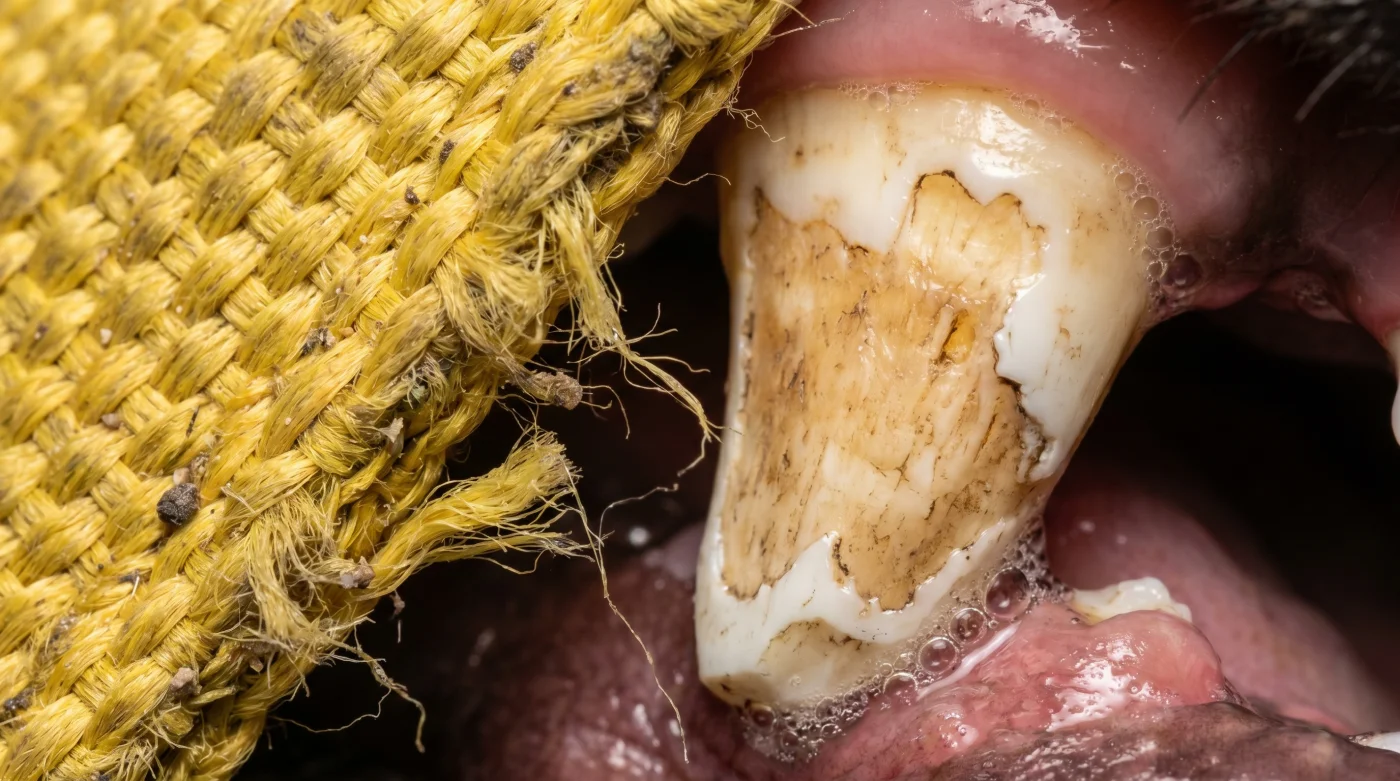
You might notice a slight flattening on the tips of their canines, or a yellowish hue showing through the bright white of their back molars. Enamel does not grow back. Every hour spent grinding against industrial Kevlar is a permanent withdrawal from your dog’s oral health.
The Belt Sander in the Toy Box
We tend to view a dog’s chewing habit as a war of attrition. The goal, we assume, is to find a material harder and more stubborn than a pitbull’s bite force.
This is where the logic breaks down. When a dog gnaws on ballistic nylon or Kevlar-reinforced fabric, the toy acts like a wet pumice stone. Saliva traps microscopic grit against the tough, unyielding threads, creating a highly effective abrasive surface that files down teeth with shocking speed.
You want a material that displaces force, not one that fiercely resists it. Think of biting your own teeth into a thick, dense block of rubber versus biting down on a thick canvas tarp. The rubber pushes back gently, absorbing the mechanical stress. The tarp grips and grinds.
Dr. Marcus Thorne, a forty-eight-year-old veterinary dentist operating out of a quiet clinic in Bend, Oregon, started noticing an odd pattern three years ago. He identified flattened carnassial teeth in young Shepherds and Staffordshire Terriers, the kind of severe wear usually found in fourteen-year-old farm dogs.
He asked the owners to bring in their dogs’ favorite chew toys. Overwhelmingly, he found the culprits weren’t marrow bones or rocks. The damage was strictly tied to premium, military-grade fabric toys. Dr. Thorne realized these owners were spending thousands on dental crowns because they were trying to save thirty dollars on replacement toys.
The ‘Indestructible’ Test: Assessing Your Dog’s Approach
Not all power chewers dismantle their gear the same way. The specific threat a ballistic toy poses depends entirely on the mechanics of your dog’s mouth. Assessing their specific approach dictates the alternative gear you should introduce.
The Back-Molar Grinder
Some dogs take a heavy fabric toy straight to the back of their jaw, lay on their stomach, and settle into a trance-like chewing rhythm. They use their carnassial teeth to scissor and crush.
For these dogs, Kevlar is catastrophic. The continuous, concentrated friction on the back molars strips the protective outer layer rapidly, exposing the sensitive dentin underneath. Rubber displacement toys excel here, offering a satisfying, squishy resistance that tires out the jaw muscles without wearing away the tooth structure.
The Front-Incisor Nibbler
This chewer targets seams, tags, and vulnerable corners. They use their tiny front teeth to pull apart the stitching of a ballistic toy, pulling with rapid, jerky motions.
While they might not flatten their molars, the rigid nature of reinforced nylon threads catches between the teeth, leading to micro-fractures in the delicate incisors. Switching to smooth, seamless heavy-duty rubber objects denies them the friction point while protecting those fragile front teeth.
Retraining the Jaw: A Tactical Toolkit
Moving your dog away from destructive fabrics toward safer displacement materials requires a slight shift in how you manage their playtime. It is about offering the right texture at the right temperature.
Rather than leaving a Kevlar bone out permanently, treat heavy chew sessions as a managed, mindful activity. You control the environment, ensuring they get the sensory release they need without the collateral damage.
- The Freeze Factor: Take a dense, natural rubber displacement toy and soak it in water, then freeze it at 0 degrees Fahrenheit for two hours. The cold numbs the gums and provides temporary hardness that safely yields as it warms.
- Time-Boxing the Chew: Limit intensive chewing to 15-to-20-minute sessions. Even with safe rubber, the jaw muscles need a rest to prevent cramping and joint fatigue.
- Sizing Up: Always buy one size larger than the manufacturer recommends for your dog’s weight. A larger rubber toy prevents the jaws from closing entirely, shifting the mechanical stress away from the teeth and onto the muscles.
- The Smell Test: If a rubber toy smells chemically pungent, discard it. Look for natural, food-grade rubber that smells neutral or slightly sweet.
Redefining Durability
We often project our own frustrations onto the things we buy. When a dog destroys a toy, we feel defeated, outsmarted by a creature that still occasionally barks at the mailman.
True durability isn’t found in a fabric that survives a warzone. It is found in harmony between the object and the animal. When you stop trying to defeat your dog’s jaw and start accommodating it, the entire dynamic changes.
You trade the false security of an unbreakable Kevlar seam for the quiet peace of mind that comes from knowing your dog’s mouth is safe. They get to chew, satisfying an ancient, primal urge, and you get to stop sweeping up fluff.
More importantly, you preserve their ability to eat, play, and comfortably age. That is the real victory—not a toy that lasts forever, but a healthy dog that gets to enjoy every meal without pain.
“A toy should be a consumable release valve for anxiety, not an unyielding anvil that punishes the jaw for doing what it was built to do.”
| Gear Type | Wear Characteristic | Long-Term Owner Value |
|---|---|---|
| Ballistic/Kevlar Fabric | High abrasion; acts like a wet file against enamel. | Eliminating these prevents thousands in dental crown surgeries. |
| Hardened Nylon Bones | Non-yielding; can cause slab fractures under heavy bite force. | Avoiding these protects back molars from catastrophic cracking. |
| Natural Rubber Displacement Toys | Yields to bite force; safely absorbs mechanical stress. | Offers true longevity for both the toy and the dog’s oral health. |
Frequently Asked Questions
Are all fabric dog toys dangerous for teeth?
No. Soft plush toys are generally safe for enamel, though they pose ingestion risks. The dental danger specifically arises from rough, ballistic-grade canvas and Kevlar blends designed to resist puncturing.How can I tell if my dog’s teeth are wearing down?
Look for flattening on the tips of their canines (the fangs) or a brown or yellowish circle appearing in the center of a worn flat spot, which indicates exposed, sensitive dentin.What exactly is a displacement toy?
A displacement toy is made of dense, natural rubber that compresses under jaw pressure rather than fighting against it. It safely ‘displaces’ the mechanical force of the bite.Can puppies safely use heavy-duty rubber toys?
Puppies have softer, deciduous teeth. You should use specially formulated puppy rubber, which is slightly softer than adult power-chewer variants, to prevent damage as their adult teeth set.Why do manufacturers sell Kevlar toys if they damage teeth?
Most heavy-duty gear is engineered to solve the owner’s immediate frustration—replacing broken toys—rather than safely accommodating the biological mechanics of a dog’s mouth.